Case studies
Case study · Non-profit — gender-based violence and HIV prevention
Sonke Gender
Justice
Monitoring and evaluation across Africa
Delivered 2018
A monitoring and evaluation system for work in forty countries — captured offline in the field, checked in the office, reported to donors from verified data.
Project overview
Project snapshot
Responsibilities and status, stated plainly. Where the record is silent — a date, a measured result — the page says so rather than guessing.
- Industry
- Non-profit — gender-based violence and HIV prevention
- Target users
- Field facilitators, M&E officers, programme managers and leadership at Sonke Gender Justice; donors receive the reports
- GEMIS’s role
- Designer and builder of the monitoring and evaluation system
- Scope
- Offline-capable mobile capture, approval workflow, programme targets by country and programme, role-based views, donor reporting
- Timeframe
- 2018
- Status
- Delivered 2018
- Key deliverables
- A mobile app on which facilitators capture each session, working offline and syncing when there is signal; An approval workflow in which M&E officers check each record, so every number traces to a real activity; Progress against targets by country and programme, as it happens; Role-based views: country teams see their country, leadership the whole picture; Donor reports assembled from already-verified data
The business challenge
Monitoring and evaluation across Africa
Offline mobile capture, approval workflow, programme targets and donor reporting, for work in 40 countries.
Sonke Gender Justice works to end gender-based violence and reduce the spread of HIV in forty countries across Africa. Every day its teams run workshops, dialogues and outreach.
Funders ask a hard question: what difference did it make? Answering it meant collecting evidence from sessions held far from any office, often without signal, and then proving that the numbers in a report corresponded to real activities.
The problem was both capture and credibility: getting field data in reliably, and making it trustworthy enough to report.
Discovery and evidence
What the design was based on
Only the evidence that exists is described here. Nothing is labelled research that was not.
The record holds no research report for this project. The design follows the question funders ask — what difference did it make? — and the conditions under which the answer has to be gathered: sessions held far from any office, often without signal, across forty countries.
The problem was both capture and credibility: getting field data in reliably, and making it trustworthy enough to report.
Strategy and system structure
Why this approach fits the problem
- Capture where the work happens, with or without signal
- Verify before counting
- Show each role only what it needs
The system starts in the field: facilitators capture each session on a mobile app that works offline and syncs when there is signal, so a lack of connectivity never means a lost record.
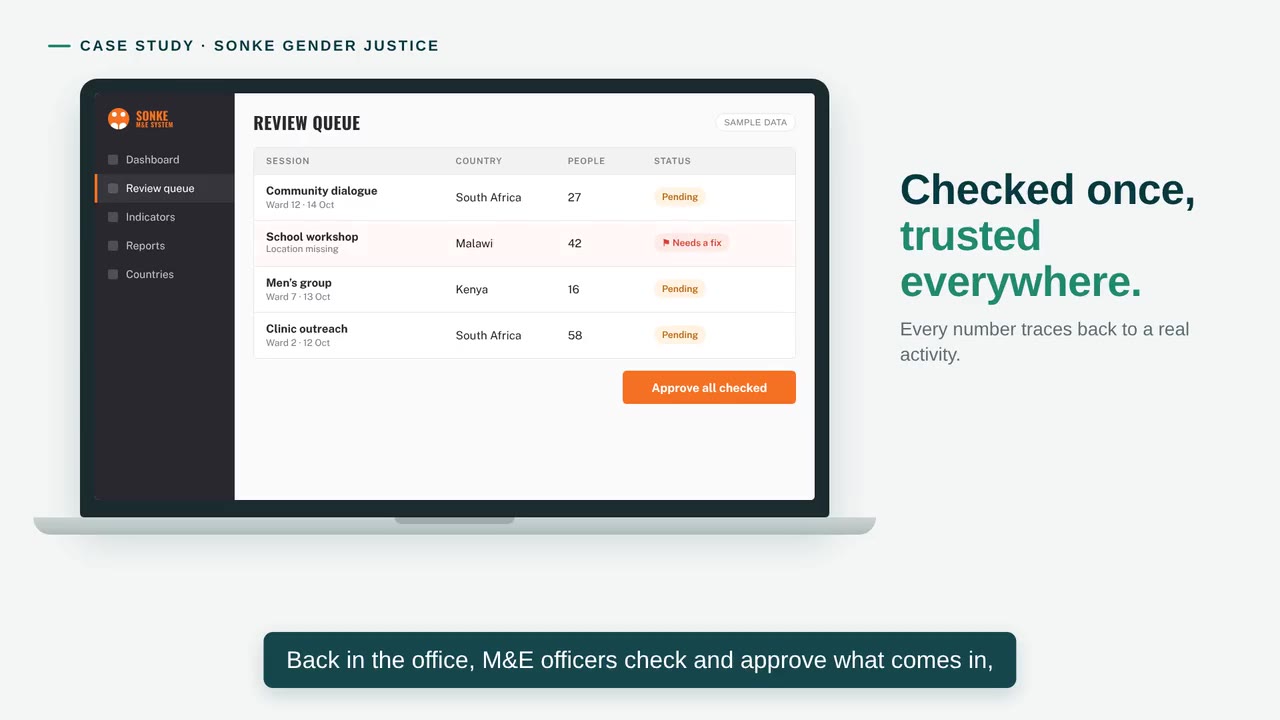
Nothing counts until it is checked. M&E officers review and approve what comes in, so every figure in a report can be traced back to a real activity — which is what makes the reporting credible to funders.
Programme managers see progress against targets by country and programme as it happens, each role sees the view it needs, and donor reports come together from data that has already been verified.
GEMIS built Sonke Gender Justice a monitoring and evaluation system. Facilitators capture sessions on an offline-capable mobile app; M&E officers check and approve each record so every number traces to a real activity; programme managers track progress against targets by country and programme; each role sees the view it needs; and donor reports build from already-verified data.
Read the transcript
Sonke Gender Justice works to end gender-based violence and reduce the spread of HIV, in 40 countries across Africa. Every day, teams run workshops, dialogues and outreach. But funders ask a hard question: what difference did it make? So GEMIS built Sonke a monitoring and evaluation system. In the field, facilitators capture each session on a mobile app. It works offline, and syncs when there's signal. Back in the office, M&E officers check and approve what comes in, so every number can be traced to a real activity. Programme managers see progress against targets by country and programme, as it happens. Each person sees what their role needs: country teams their country, leadership the whole picture. When reporting time comes, the figures are already there. Donor reports come together from data that has already been checked. Less time on paperwork. More time on the work that matters. Built by GEMIS.
The workflow as implemented
- Captured in the field Facilitators record each session on the mobile app, offline
- Synced When there is signal, the records come in
- Checked M&E officers review and approve each record
- Counted Only approved activity counts against targets
- Seen by role Country teams see their country; leadership the whole picture
- Reported Donor reports assemble from already-verified data
The system, step by step
What the user needs to do, and how the system supports it
Stills from the case study video. The interfaces are illustrated for the video, not screen recordings of the production system; every capability shown is one the system delivers.
-
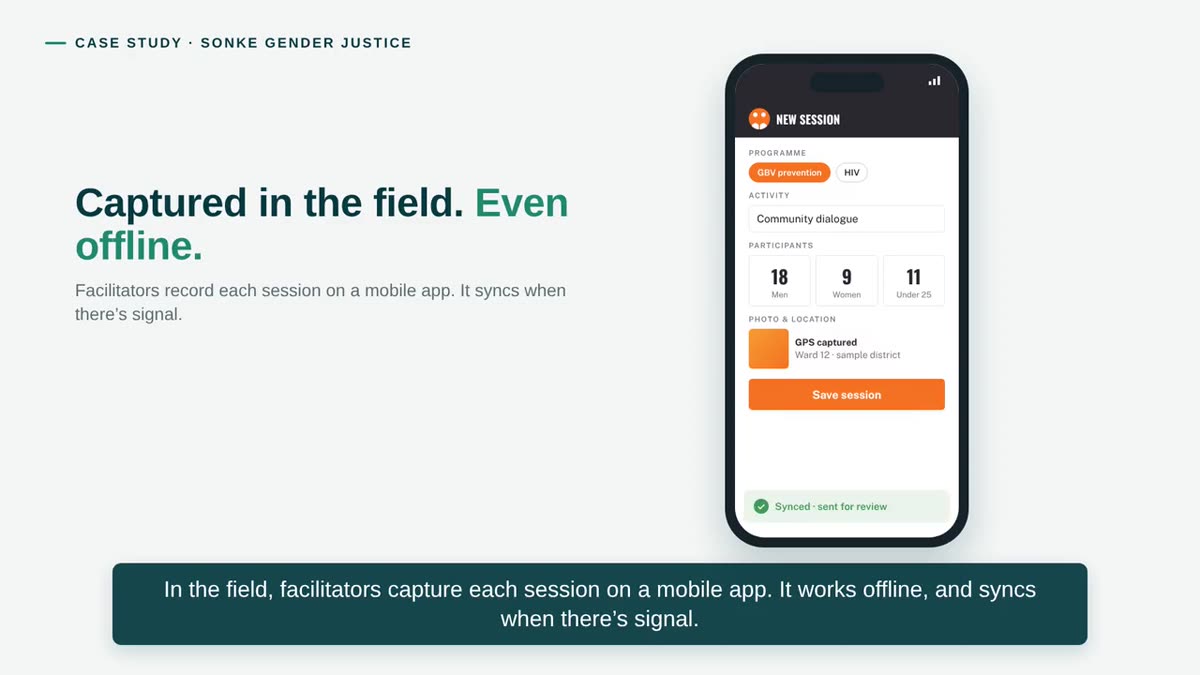
Illustrated in the case study video Captured in the field. Even offline.
Facilitators capture each session on a mobile app. It works offline and syncs when there is signal, so a lack of connectivity never means a lost record.
-
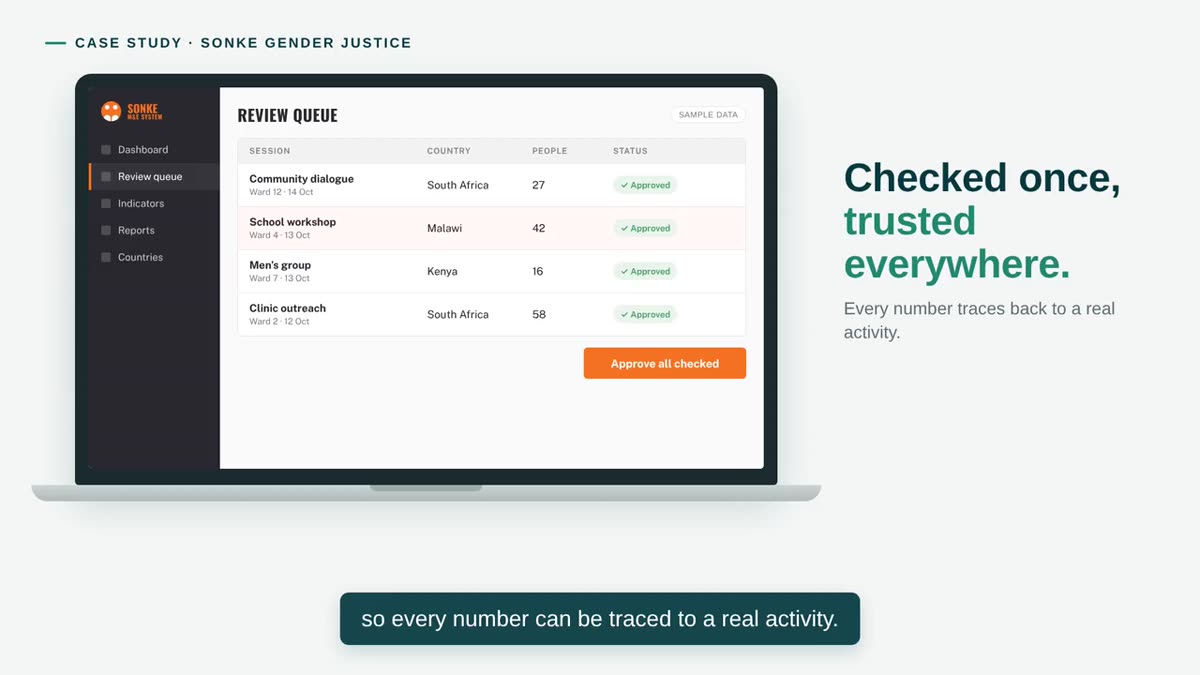
Illustrated in the case study video Checked once, trusted everywhere
Back in the office, M&E officers check and approve what comes in, so every number can be traced to a real activity.
-
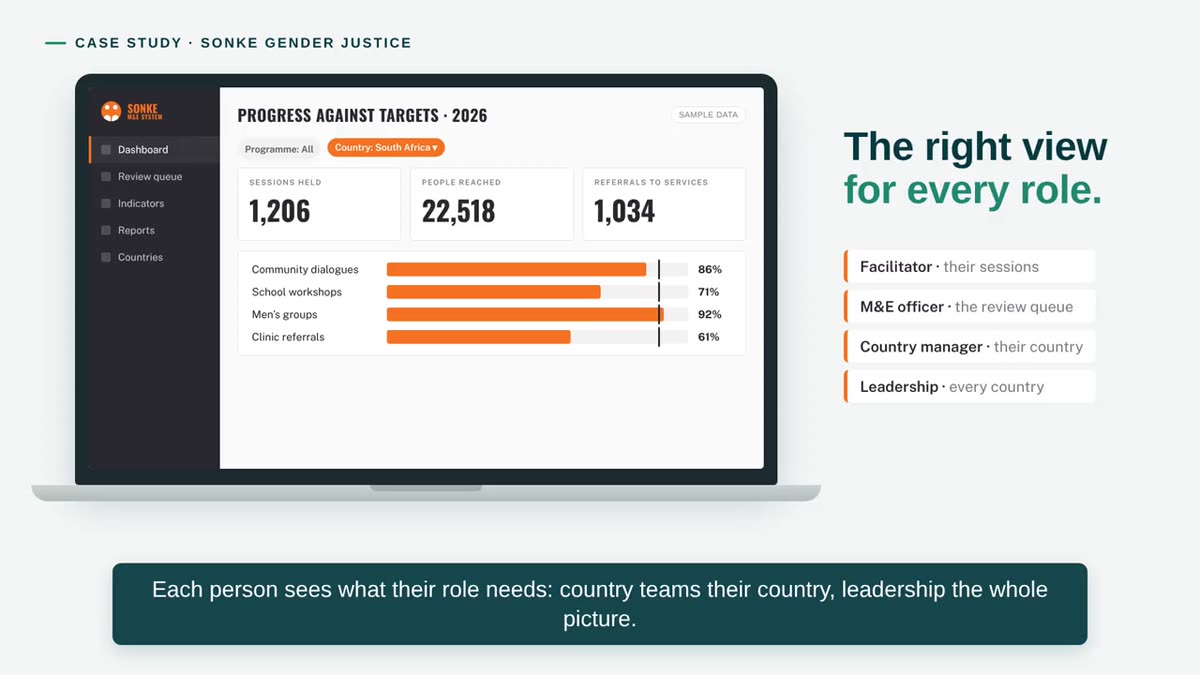
Illustrated in the case study video The right view for every role
Programme managers see progress against targets by country and programme; each person sees what their role needs.
-
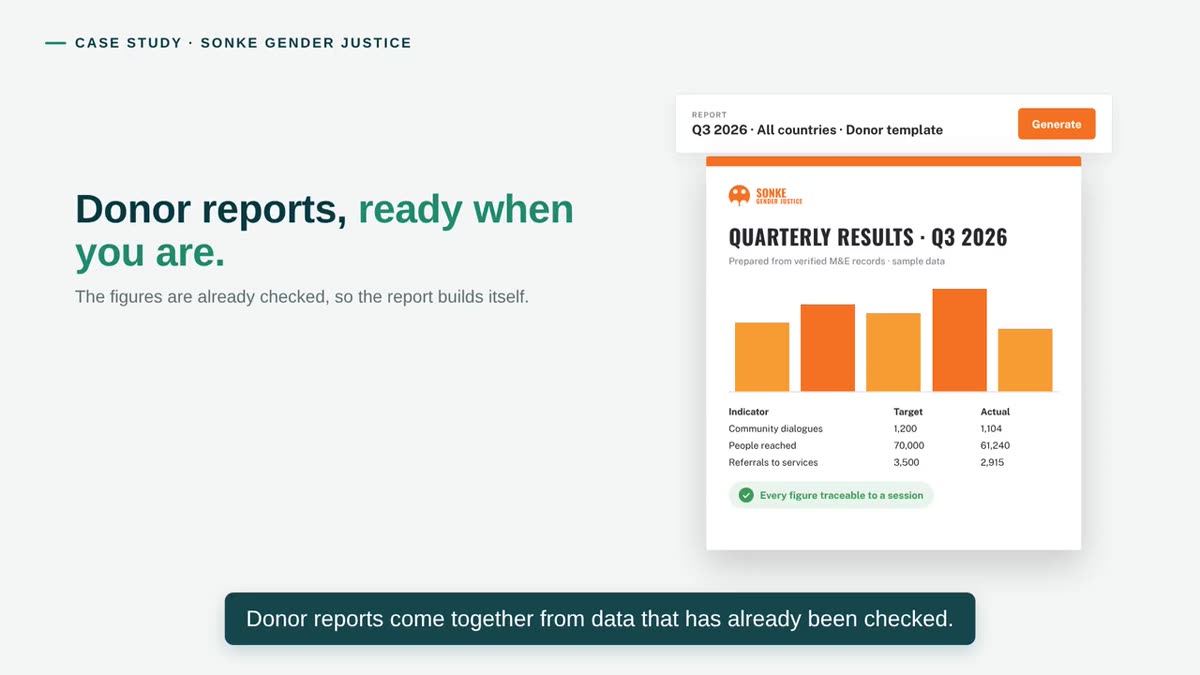
Illustrated in the case study video Donor reports, ready when you are
When reporting time comes the figures are already there, assembled from data that has already been checked.
Key decisions
Why it was built this way
The decisions the evidence supports: what needed addressing, what GEMIS chose, why, and what was delivered or observed.
-
- Challenge
- Sessions happen far from any office, often without signal.
- Decision
- An offline-first mobile app that syncs when there is signal.
- Rationale
- If capture depends on connectivity, the records that matter most — the remote ones — are the ones lost.
- Evidence or effect
- Delivered, as shown in the case study.
-
- Challenge
- Funders need to trust that reported numbers correspond to real activities.
- Decision
- Nothing counts until an M&E officer has checked and approved it.
- Rationale
- An approval step between capture and counting is what makes every figure traceable to a session.
- Evidence or effect
- Delivered, as shown in the case study.
-
- Challenge
- Country teams and leadership need different views of the same data.
- Decision
- Role-based views: each role sees what it needs, and progress against targets is live by country and programme.
- Rationale
- One system can serve the field, the office and leadership if each sees its own slice rather than everything.
- Evidence or effect
- Delivered, as shown in the case study.
Validation, delivery and iteration
What the record shows
Delivery and continued use are the validation the repository can evidence. What it cannot, it says.
On record
- Delivered in 2018 (facts.md).
Not documented
- Whether the system remains in use, usage figures, usability testing and user-acceptance records are not in the repository, so none are claimed.
Outcomes and business value
Donor reports build from data that has already been checked
Delivered work, verified results and intended benefits are kept apart. Nothing here is a metric the client has not confirmed.
Delivered
- An offline-first mobile capture app
- An approval workflow and traceable records
- Target tracking, role-based views and donor reporting
Intended benefits
- Less time on paperwork for field and office teams
- Donor reports built from verified data rather than reconstructed figures
- Programme decisions made on current progress against targets
Built on Mobile · offline sync · SQL · reporting
Related work
Two projects that share the pattern
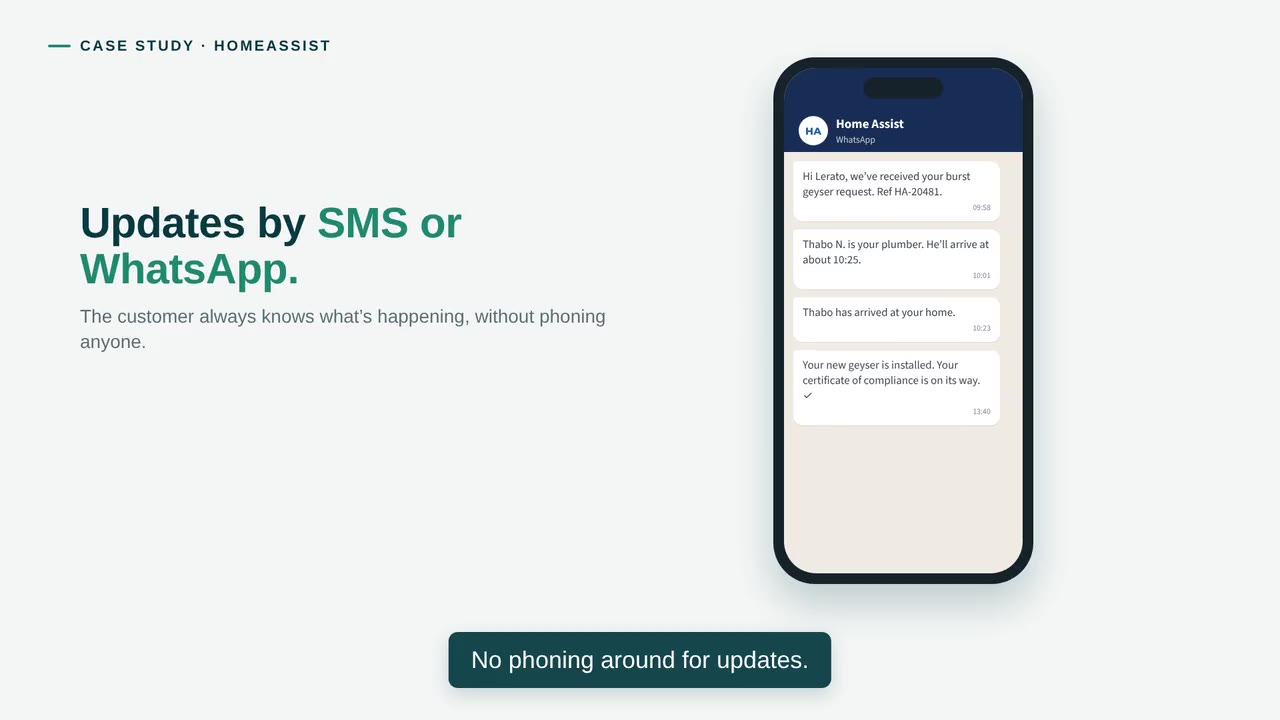
Insurance and home services — plumbing repairs
HomeAssist
Plumbing claims, from report to sign-off
- Field operations
- Integration
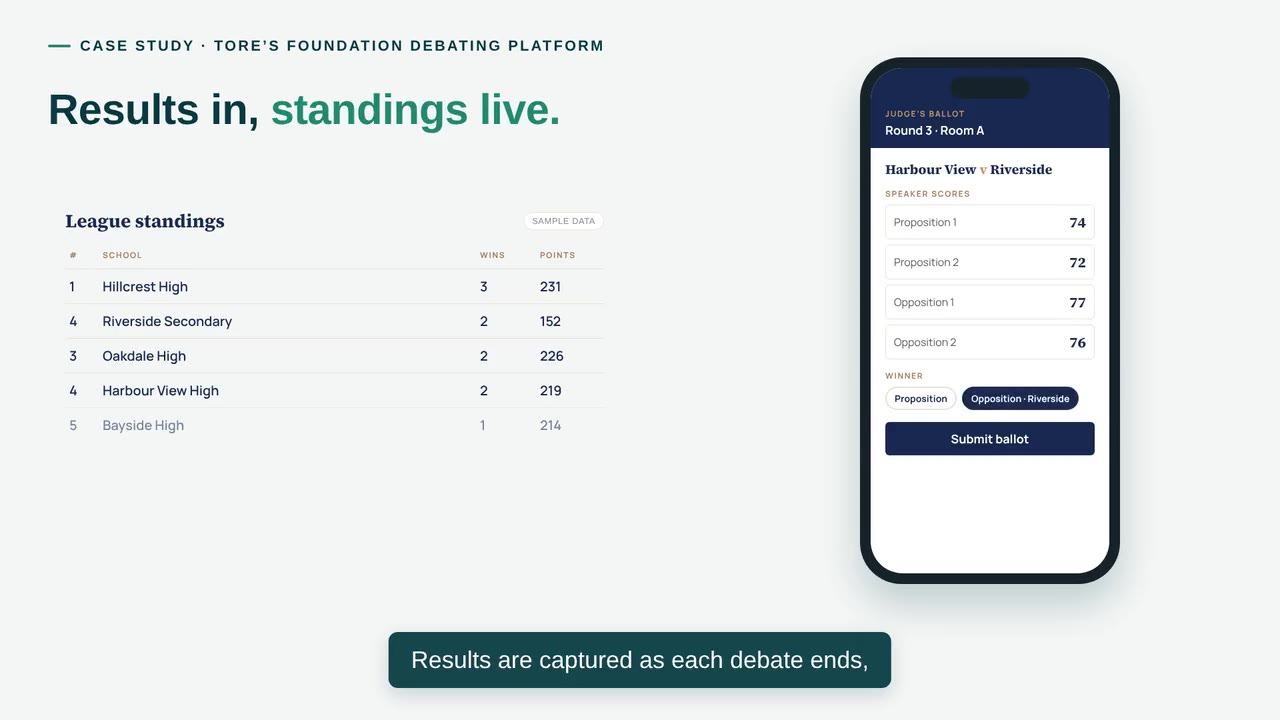
Education — schools debating programme
Tore's Foundation
A debating platform for 24 schools
- Platforms
Next steps
Reporting to funders from field data you cannot fully verify? Let’s talk about capture, approval and reporting in one system.
Tell us what the business needs to do better. We come back within two working days with a short written view and a time to talk — no obligation.